What We Do

We help customers find you, on Google and in AI answers

Two things decide whether a new customer finds you: where you come up on Google, and whether an AI assistant names you when they ask. We work on both as one job, on a site built so both can happen.

How we work

From the first call to winning searches

Four steps, the same for every client. The first three get you found. The fourth keeps you there, with 6AI Analytics every 72 hours and a report every 1 to 3 weeks.

  1. 01

    We meet

    A first call to learn what you sell, where you sell it, and who you want to find you.

    • What you sell and where
    • Who your customers are
    • What they search for
    • Whether we can help
  2. 02

    We check your baseline

    We run our checks through your site and its code, and record where you rank on Google and how often AI answers name you today.

    • Every page and its code
    • Where you rank on Google
    • What ChatGPT, Perplexity, and Google's AI mode say
    • What competitors show up instead

    How the checks work

  3. 03

    We fix and build

    The big first build: broken pages fixed, missing pages added, and the site set up so Google and AI start picking you up right away.

    • Broken pages fixed, missing pages added
    • Code, HTML, structured data, and llms.txt cleaned up
    • Google Search Console, Bing, and analytics set up
    • Your Google Business Profile completed

    How we build

  4. 04

    We keep you winning

    6AI Analytics runs every 72 hours and we keep making changes, so you keep winning searches. You get a report every 1 to 3 weeks.

    • 6AI Analytics every 72 hours
    • Improvements made after every run
    • A report every 1 to 3 weeks, by project
    • What changed and how you're doing

    See 6AI Analytics

What it gets you

Found, named, then called

  1. Found

    on Google

    SearchSample

    A customer searches Google for “fee only financial advisor austin”.

    1. 1Pellbrook Financial Planning
    2. 2Quarrystone Wealth
    3. 3Bramblecote Advisors
  2. Named

    in ChatGPT, Perplexity and Google's AI answers

    AI answerSample

    Who's a good fee-only financial advisor in Austin?

    Pellbrook Financial Planning is a fee-only practice in Austin.

    It publishes its fees and plans retirement and tax together.

    pellbrookplanning.example

  3. Called

    the enquiry arrives

    PhoneSample

    New call · from a Google search

    To Pellbrook Financial Planning

    Austin, TX · just now

Sample · illustrative data · Pellbrook Financial Planning is not a real company.
  1. Found on Google

    We work on the searches your customers type when they need what you sell, and on the pages that answer them.

    Every page gets its own title, description and structured data. Positions are checked by hand, logged out, so the number you see is the one your customer sees.

  2. Named when they ask AI

    More people now ask ChatGPT who to call. We make your site something it can read, trust and quote.

    Structured data, your name and address written the same way everywhere, and sentences that still make sense when an assistant lifts them out. We count how often ChatGPT, Perplexity and Google's AI mode name you, nine runs each.

  3. Easy to call once they find you

    Being found only pays off if the person gets in touch, so the page they land on makes that the obvious next step.

    The site is part of the work: a clear page for every service, location or property, a phone number and form that work on a phone, and tracking on the calls, forms and bookings that bring you business.

6AI Analytics · Included for every client

300 agents check how customers find you, every 72 hours

6AI Analytics is the run every 6AI client gets. About every 72 hours, around 300 AI agents go through how customers find your business: what they search on Google, what they ask ChatGPT and other assistants, what Google and those assistants make of your site, which pages get clicks, and what to improve next. Then we make the improvements, and you get a report every 1 to 3 weeks.

6AI Analytics · one run

~300 agents · every 72 hrs

6AI
  1. What people search
  2. How Google and AI see you
  3. What's working
  4. What isn't
  5. What to improve
  6. Improvements made
Every dot is one agent. The run ends in changes to the site, and the next run checks whether they worked.
AI agents in every run
~300AI agents in every run
between runs, or weekly if your site needs less
72 hrsbetween runs, or weekly if your site needs less
places we look: Google, ChatGPT, Perplexity, and Google's AI mode
4places we look: Google, ChatGPT, Perplexity, and Google's AI mode
client gets it, as part of the work
Everyclient gets it, as part of the work
SEO & GEO

AI-Powered SEO & GEO

We help you come up when customers search Google or ask ChatGPT, Perplexity or Google's AI mode, and we build that into your site so the visit can turn into a call. There is no score out of a hundred, because you cannot check a 72 and a number can be moved without the site changing. The work starts with twelve checks against the site as it actually is: rankings, structured data, entity consistency, crawler access, placeholder content, and whether AI assistants name you when asked. Each finding comes back with the address it was found at, a UTC timestamp and a snippet you can go and look at yourself. AI visibility is counted rather than ranked: three questions a customer would ask, three runs each, in every assistant we track, reported as cited in N of 9 runs per engine with the date and the domains named. Two of the twelve are deliberately not automated, and we say which: rank positions are hand-verified logged out, because search engines block automated queries often enough that smooth position data is not what it looks like, and map listings are never scraped at all. The site is in the same engagement because access is the easy half: what usually stops a page being cited is that it has no structured data, no subject stated as text, and nothing written so a single claim can be lifted out of it.
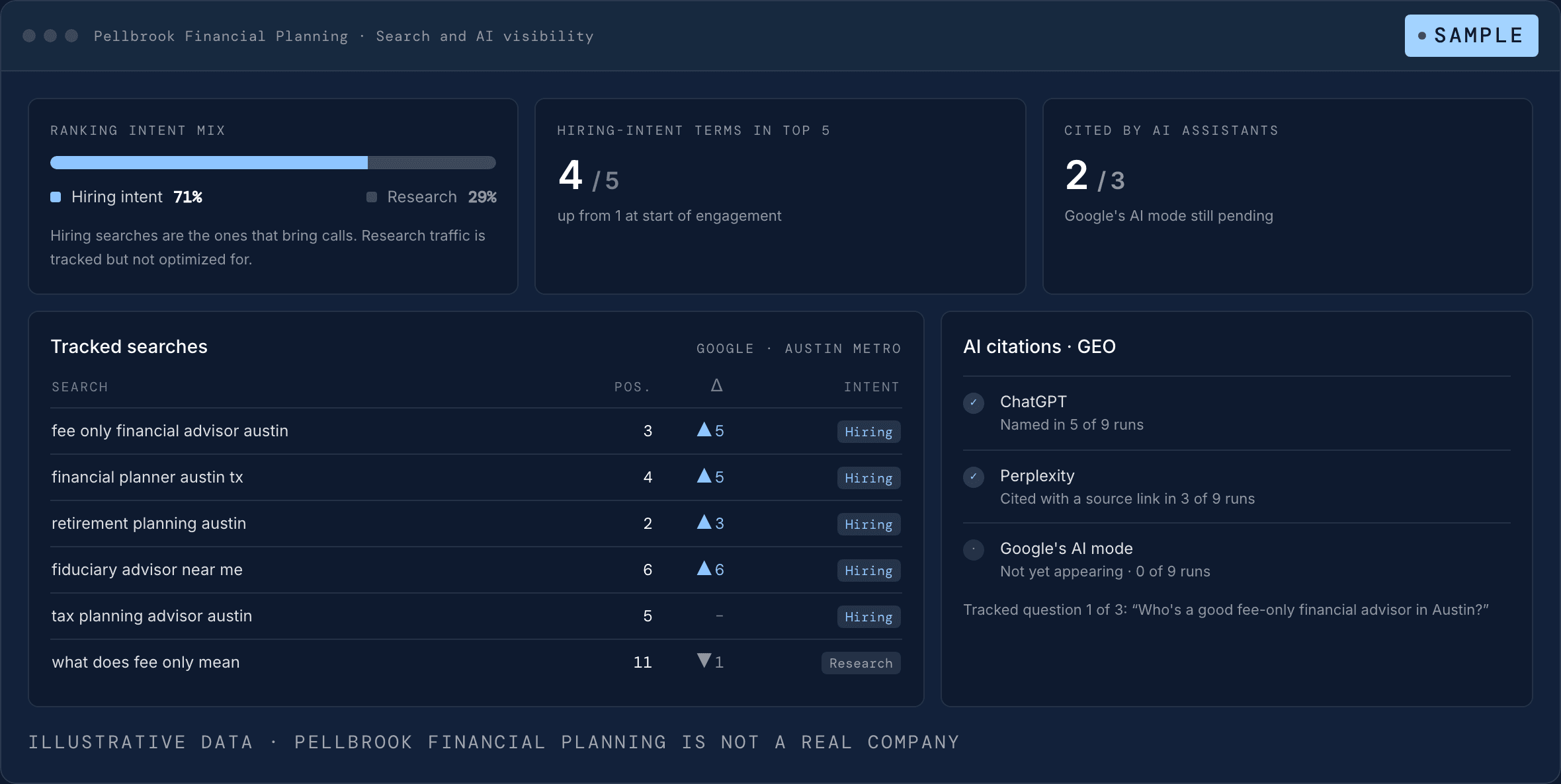
Sample product view: a visibility report with tracked searches by position and AI-assistant citations — illustrative data
Sample · illustrative data
  • Found on Google for the searches that describe what you sell, with positions hand-checked logged out
  • Named when a customer asks ChatGPT, Perplexity or Google's AI mode, counted as cited in N of 9 runs
  • One indexable page for every thing worth finding, with its own title, description and structured data
  • Calls, forms and bookings measured, so you can see what the work brought in

Part of the work

  • The website. If search engines and AI assistants cannot read your site, the rest of the work has nothing to stand on. When a site needs rebuilding, we rebuild it as part of the job. How we build sites
  • Follow-up automation. If answering new enquiries is the slow part, we can automate the follow-up too, with a person approving anything that goes out.

Why it works

Why our checks run every time your site changes

An hourly model delivers in batches: an audit at kickoff, a keyword list in week one, a report the week it is due. Most agencies are adding AI tools to that model, and faster batches are still batches. Ask an agency how many times your audit has run since the last time your site changed.

We started from the other end. The audit is code, so it runs again whenever your site changes rather than whenever the retainer says so, and the two checks we do not automate are named in the report: rank positions hand-verified logged out, because engines block automated queries, and map listings never scraped. Search-intent research happens per page instead of per engagement. Pages that repeat are generated from data, so the fiftieth is as correct as the first. And the newest part of the job, whether an assistant names you when someone asks it who to hire, is tested by asking the assistants, nine runs each on a fixed protocol, because no monthly process can even see it.

The other half is who the work is for. People still use Google, and increasingly they also ask ChatGPT, Perplexity or Google's AI mode, the three we track, to compare providers and build a shortlist. Those systems do not rank links; they quote sources. Being quotable is a different technical problem from being rankable. Most sites were built before anybody asked the question, and ranking well does not mean you have solved it.

Want to know how you show up?

Tell us what you sell and where, and we will show you how you come up on Google and in ChatGPT today.