Web Services for the AI Era

Your customers have started asking AI instead of scrolling Google. We make sure you show up in both.

Our Approach

AI does the work, not the billing

Traditional agencies bill hours for work that AI can now do continuously, and most of them are adding AI tools to an operating model built before any of this existed. We were built the other way round: agents run the research, the audits, the optimization and the reporting, and a person approves anything that goes out. Faster movement, lower cost, and work that holds up in the places people have started searching instead.

01

The audit is code, not a PDF

A program checks your site, not a person with a notepad — so it can run again every time your site changes.

Twelve checks run against your raw HTML. Not a text extraction — those strip the script tags structured data lives in, which is how you get a confident, false “this site has no schema” finding.

02

Every finding carries its receipt

We give you the exact page, the date we looked, and what we saw. You can go and check it yourself.

The address it came from, a UTC timestamp, and the snippet we read. No composite score and no traffic estimate. Scorecards expire after thirty days, because a site can change.

03

AI citations are counted, never ranked

We ask ChatGPT, Perplexity and Google's AI the same questions nine times, and count how often they name you.

Three questions, three runs each, across ChatGPT, Perplexity and Google AI. We report “cited in N of 9 runs” with the date and the domains cited. There is no rank inside an AI answer, so we never invent one.

04

Nothing an agent writes sends itself

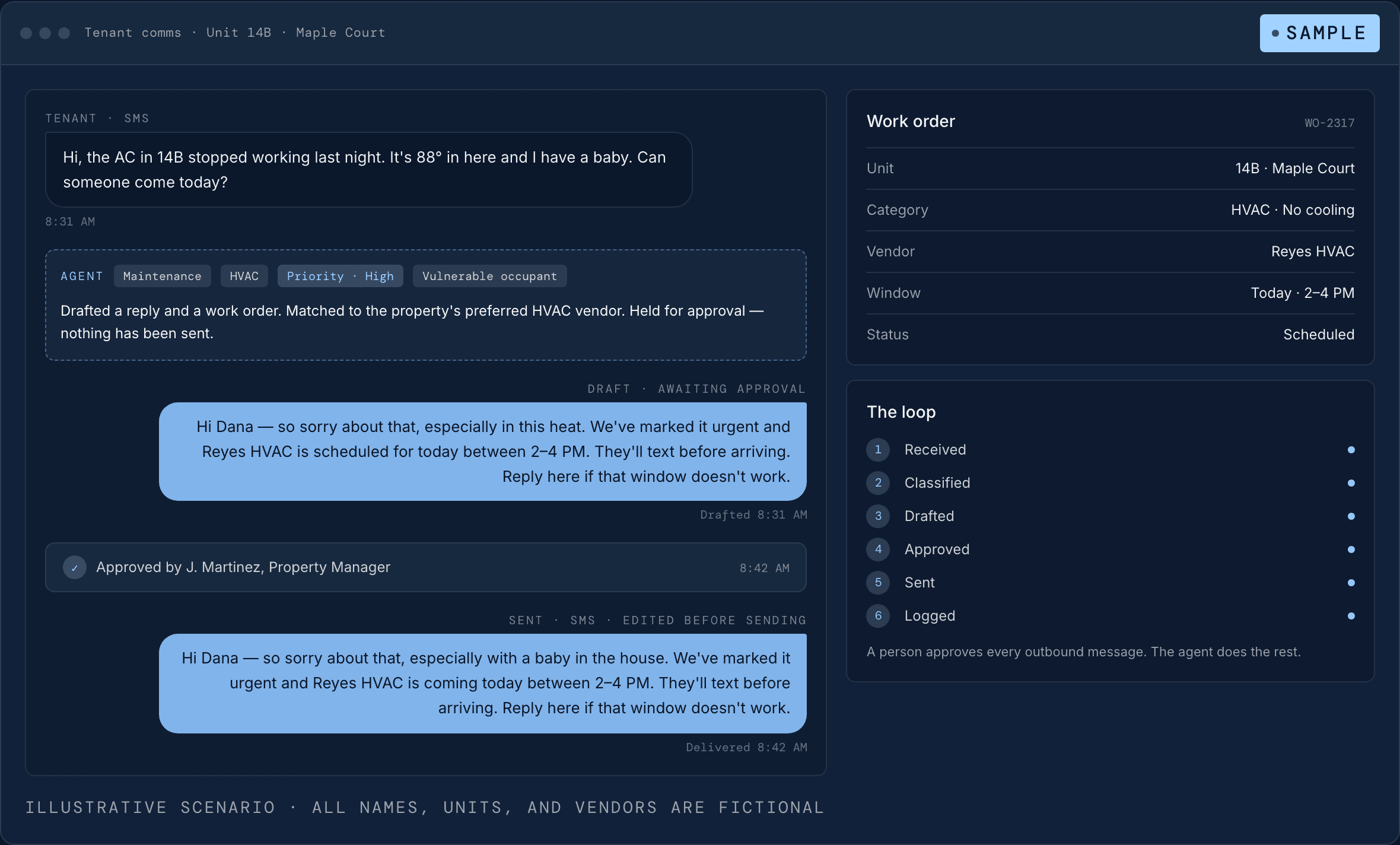
A person approves every message before it goes out. Ours included.

Draft, approve, send — with a person on the approve step. We run our own email and posts through that loop, which is how we know where it breaks rather than where we imagine it does.

What We Do

The new SEO, and the machine behind it

Two things decide whether anyone finds you: where you rank on Google, and whether an AI assistant names you when someone asks. We do both, and we show our work.

Ten of our twelve checks execute as code against the raw HTML your server sends, and they run again whenever your site changes rather than whenever a retainer allows. The other two are manual on purpose and we name them. Every finding arrives with its address, a UTC timestamp and a snippet you can open yourself. There is no score out of a hundred, because you cannot check a 72. Search-intent research happens per page instead of per engagement, and page types that repeat are generated from data, so the fiftieth page is as correct as the first.

The New SEO

AI-Powered SEO & GEO

Ranked on Google and named when a customer asks an assistant, with the address, the date and the snippet behind every claim — on a site built to have something worth quoting on it.

We run on it too

Connected Workflows & Automation

The work that repeats after the enquiry arrives, wired into the software you already pay for, including the platforms with no API. Nothing sends without a person approving it, and our own outbound goes through the identical loop.

The product

See exactly where you show up

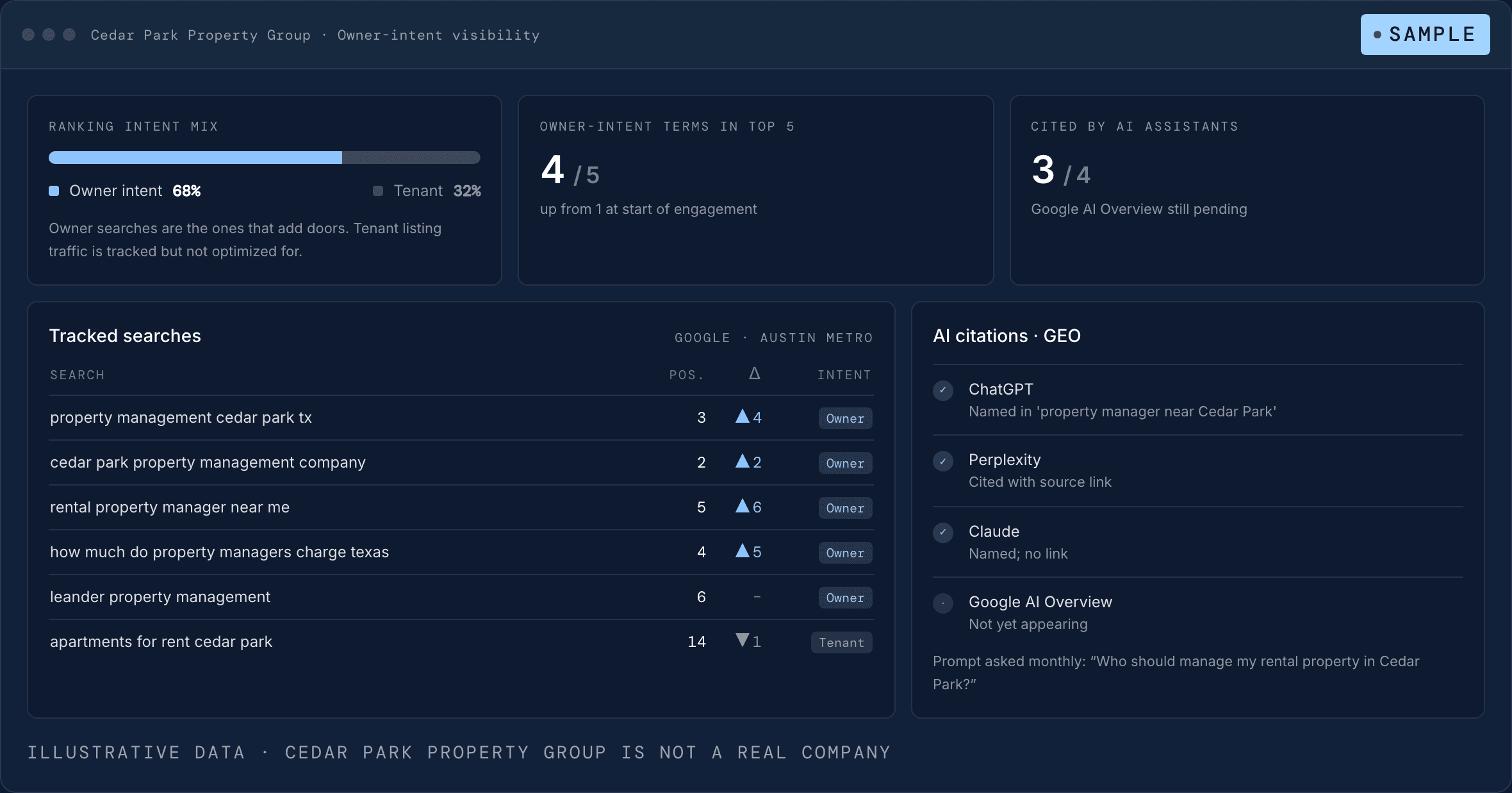
Sample product view: a visibility report with tracked searches by position and AI-assistant citations — illustrative data

Sample · illustrative data

Every search you are tracked for, where you rank, and which AI assistants named you — each with the date we checked. No score out of a hundred.

Industries

Where we go deepest

Search works the same way everywhere. Knowing which query a customer actually types, and which page type answers it, does not — and that is what we research per market. These four are where we have done the most work, and we are still adding to the list.

  • Property Management

    Owner acquisition, doors under management, and the operational work behind both.

  • Media & Entertainment

    Shows, catalogues and the words inside them — found in search, quoted in AI answers.

  • Finance

    Credibility, clarity and correct representation — inside the rules that apply to your firm.

  • Sports & Recreation

    Programs, locations and seasons — findable, consistent, and easy to register for.

How deep the work goes in each is written on the page itself — including the one where it is thinner.

Team

The people building 6AI

6AI is run hands-on by its founders. We do the work ourselves — building the sites, running the SEO, and shipping the automation — rather than routing it through account managers. Read more about what 6AI is.

Meet the whole team
Our Mission

Automate everything

That is the mission — not a slogan, but how this company actually runs. Neither founder sends an email by hand: a rough draft goes to Baraq or Claude, the agent writes it properly, asks for approval, and sends it. Our LinkedIn posts run through the same loop. When we are weighing a new business idea, we ask Baraq what he thinks first — he reasons through it with more depth than you would expect.

The judgment calls stay human — nothing goes out without an approval. Everything else — the writing, the scheduling, the follow-up, the busywork — is automated. We hold our own company to the standard we sell, which is how we know what works before we ever build it for you.

Sample product view: a tenant maintenance request classified and drafted by an agent, approved by a property manager, then sent — illustrative data
Sample · illustrative data
  1. 01

    Draft

    We hand the agent a rough idea — a few lines of what needs saying.

  2. 02

    Write

    Baraq or Claude turns it into the finished email or post.

  3. 03

    Approve

    It comes back to us for a yes. Nothing goes out without one.

  4. 04

    Send

    The agent sends it — we never touch the send button.

FAQ

Frequently Asked Questions

What is 6AI?

6AI (pronounced “Six AI”) is an AI-powered SEO and GEO company headquartered in Austin, Texas, building web services for the AI era. We run the SEO and GEO that gets companies ranked on Google and cited in AI answers, build that work into the site itself, and automate the work that repeats behind it, with a person approving anything that leaves the building. Ten of our twelve audit checks run as code against raw HTML and re-run whenever a site changes, every finding carries the address and the date it came from, and AI citations are reported as a count of runs rather than a rank. We go deepest in property management, media and entertainment, sports and recreation, and finance. Read what 6AI is →

What does “AI-native” actually mean at 6AI?

It means the work that used to be too expensive to repeat now runs continuously. The audit executes as code against your raw HTML, never a text extraction, because extraction strips the script tags structured data lives in — a stripped read once produced exactly that false finding, which is why the code now carries a self-test proving it cannot come back quietly. Because it is code, it re-runs whenever your site changes rather than whenever a retainer allows; work priced by the hour cannot do that. Ten of the twelve checks run that way, and we name the two that do not: rank positions hand-verified logged out, because engines block automated rank queries, and map listings never scraped. Every finding comes back with the address, a UTC timestamp and a snippet you can open yourself, and there is no composite score, because you cannot check a 72. The judgement stays where it was — a person approves anything that goes out. How we build →

Why do you go deep in a few industries?

Because the technical work transfers between industries and the demand does not. A site is judged by the same standards everywhere, but knowing which query a customer actually types, and which page type answers it, is learned per market — and getting it wrong wastes a quarter. Property management is the clearest example: it runs on a known set of repetitive workflows and a known set of software, and owner-intent search behaves nothing like generic local SEO. Going deep is what makes personalizing affordable, because the time we spend with you goes into what is specific about your operation rather than into the basics.

Do you only work in the industries you list?

No, and the list is still growing. Those four are where we have done the most work, which is why they get their own pages. The systems underneath are not industry-specific: a website is judged by the same technical standards everywhere, search works the same way everywhere, and repetitive work is repetitive work in any business. Property management is where we have gone deepest. The first call works the same way regardless — we map where the opportunity is and tell you honestly whether we are the right fit. See the industries →

What property management tasks can you automate?

The repetitive ones. Communications — tenant, owner, and prospect messaging across email, SMS, and phone. Tenant updates — notices, renewals, move-in and move-out, maintenance status. Financial — rent-collection follow-up, delinquency chasing, owner statements, reporting prep. Legal and compliance documents — notice generation, lease paperwork, and deadline tracking. Data — syncing between systems, cleanup, entry, and migration. And dashboards that give you one live view of the portfolio instead of scattered spreadsheets. Learn more →

Does this work with AppFolio, Buildium, Yardi, or Rent Manager?

Yes. We build around the software you already run rather than asking you to switch. Where a system offers an API we integrate directly; where it doesn't, we work with the exports, inboxes, and interfaces it does expose. The first conversation covers what you use and what it can and cannot connect to, so nothing is promised before we know it works.

How does SEO actually bring in more doors?

Owners deciding who should manage their property start by searching — “property management [city]”, “rental property manager near me”, or increasingly by asking ChatGPT or Perplexity for a recommendation. If you are not in those results, you never enter consideration. We target the owner-intent searches specifically, rather than optimizing for traffic that is mostly tenants looking for a listing. The number that matters is owner enquiries and doors added, not sessions. Learn more →

What is GEO, and why does it matter now?

GEO is generative engine optimization: being the source an assistant quotes when it answers a question directly instead of returning links. It matters now because a growing share of customers never reach a list of links, and because being quotable is a different technical problem from being rankable. A page ranks on relevance and authority. It gets quoted when a machine can tell what the page is and lift one claim out of it without the paragraph around it — which means structured data, the same entity signals in the same words on the site, in the markup, in the map listing and in the directories, content written so a single sentence survives being pulled out, and a machine-readable summary at llms.txt. Most sites were built before anybody thought to ask a machine a buying question, which is why so few of them are quotable. We measure it by asking: three questions a customer would actually ask, three runs each, in ChatGPT, Perplexity and Google's AI mode, reported as cited in N of 9 runs with the date and the domains named. Never as a rank — there is no rank inside an AI answer, and anyone reporting one is inventing it. Learn more →

How big does our portfolio need to be?

There is no minimum door count. What matters is whether your team is losing hours to repetitive work, or whether owners are failing to find you in search. Smaller portfolios often see automation pay off fastest because there is no back-office staff to absorb the load; larger ones tend to get more from dashboards and data work. Most companies have something worth fixing on both sides.

How quickly do you see results?

Automation usually shows up first — a communication or notice workflow can be live and saving hours within weeks. Search is slower, and anyone who gives you a date is guessing: it depends on your site's technical health, the authority you already have, and who else wants the same queries. What we do instead of promising a date is take the baseline before any work starts — where you rank, hand-verified logged out, and how many runs name you when we ask the assistants directly — so every number afterwards is a comparison rather than an assertion. One caveat we give everybody up front: answers to a prompted question move faster than answers to an unprompted one, so early silence is not failure and early success is not the whole picture.

How is this different from a traditional agency?

An audit is something a person sits down and does, so at agency prices it happens at the start of an engagement and maybe once a quarter after that. Ours executes as code, so running it again costs almost nothing, and it runs again whenever your site changes rather than whenever the retainer says so. Work priced by the hour cannot do that at any level of effort. The same economics decide the rest: search-intent research happens per page instead of per engagement, because checking what a search box actually suggests takes seconds, and page types that repeat are generated from data, so the fiftieth page is as correct as the first. And the newest part of the job — whether an assistant names you when somebody asks it a buying question — is not something a monthly process can even see, because the answer varies between runs on the same day. That is why we ask three questions a customer would actually ask, three runs each, in each assistant we track, and report how many of those nine runs named you, with the date and the sources.

Do you actually use this automation yourselves?

Yes — it is the whole premise. 6AI's mission is to automate everything, starting with ourselves. The founders do not manually send email or publish LinkedIn posts: an AI agent — Baraq, our own AI employee, or Claude — drafts the work, asks for approval, and sends it once a person signs off. Business ideas get reasoned through with Baraq before we act on them. Every automation we sell to a property management company was proven on our own operation first. Read our mission →

What does working with 6AI look like?

A call first, to find out whether there is anything here worth doing. Then the audit, which is where the engagement actually starts: twelve checks run against your site as it actually is, and an AI-visibility baseline taken before anything changes, because without a before there is no after. You get the findings themselves — each carrying the address it was found at, the date it was checked and a snippet you can open — rather than a score. Usually the biggest time sink is not where people assume. From there some engagements are ongoing, with the audit re-running whenever the site changes and the automation expanding; others are a defined build we complete and hand off.

What technologies do you work with?

On the frontend: Next.js, React, Tailwind CSS. On the backend: Supabase, Node.js, REST APIs, PostgreSQL. AI and agents: Anthropic Claude, OpenAI, multi-agent systems, MCP integrations, and LLM-powered pipelines. We integrate with the property management platforms our clients run, plus the email, SMS, and document tools around them. On the SEO side: technical audits, structured data, content and keyword systems, analytics, and AI-answer visibility work.

Where are you based?

We are based in Austin, TX. We work with companies everywhere — our home is Austin but our reach is not limited to it.

How do I get in touch?

Use the contact form on this page or email us at roman@6aiatx.com, and we will get back to you shortly. Go to the contact form →

Let's Talk

Tell us where you want to rank, or which repetitive work is eating your team's week. We'll come back with a plan.

A site that needs rebuilding, visibility that needs to improve, a content system that needs structure, leads that need faster follow-up, or repetitive work behind any of it. Companies of every size — no minimum.